
Hygrometric Control in Wineries and Distilleries
Humidity control in wineries and distilleries is a key factor in the environmental management of facilities dedicated to the maturation and storage of high‑value products. In these environments, the balance between temperature and relative humidity (RH) directly influences final product quality, process stability, and the preservation of infrastructure.
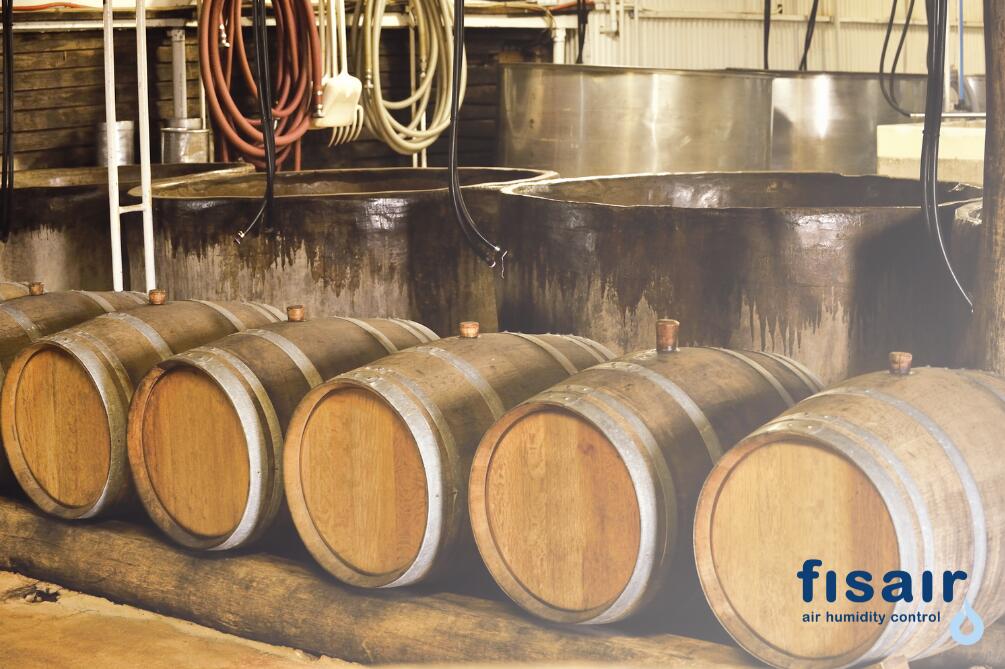
Insufficient relative humidity can have a significant economic and operational impact. In barrel rooms and ageing areas, low RH levels accelerate evaporation from the barrels, increasing the well‑known evaporation loss or angel’s share, which under unfavorable conditions can reach around 5% per year. Excessively dry environments also promote wood desiccation, deterioration of labels and packaging, and increased hygrothermal instability throughout the facility.
For this reason, in most wineries and distilleries the objective of environmental control is controlled air humidification, in order to maintain relative humidity within optimal and stable ranges. The integration of industrial humidification systems therefore becomes an essential element of HVAC design in ageing, maturation, and storage areas.
Among the most widely used technologies are steam humidification systems, either using electric generators or boiler steam, as well as adiabatic evaporative humidification systems, which are particularly suitable for large volumes and dry air conditions. These solutions allow relative humidity to be increased while naturally and efficiently reducing air temperature, making them especially suitable for barrel rooms and maturation areas, as is the case with AtomSpray evaporative cooling and humidification systems used in applications within the wine and food industries.
A properly selected and correctly sized humidification solution makes it possible to maintain uniform humidity throughout the treated space, reducing evaporation losses, improving the organoleptic stability of the product, and protecting barrels, wooden structures, labels, and auxiliary materials.
From an operational perspective, industrial humidification systems can be integrated with BMS (Building Management Systems), PID controllers, and continuous data logging systems, facilitating relative humidity monitoring, data traceability, and compliance with quality and audit standards.
The implementation of controlled humidification strategies in wineries and distilleries not only helps minimize economic losses, but also improves operational efficiency, sustainability, and process reliability. In a sector where product quality and preservation are critical, precise relative humidity control becomes a strategic factor with high added value.
Leave a reply