
Summer and Data Centers: Efficient Cooling Strategies and Environmental Control
With the arrival of summer in Europe and North America, data centers face one of the most demanding periods of the year. Rising outdoor temperatures increase cooling requirements and, consequently, energy consumption—especially in high-density environments where thermal stability is critical.
This context also coincides with sustained growth in the sector. The expansion of cloud computing and artificial intelligence is increasing both power density and heat dissipation requirements. At the same time, energy costs in Europe remain high and volatile, making cooling a key focus for operational optimization.
In this scenario, combining thermal control and humidity control technologies enables simultaneous improvements in energy efficiency, reliability, and total cost of ownership of data centers.
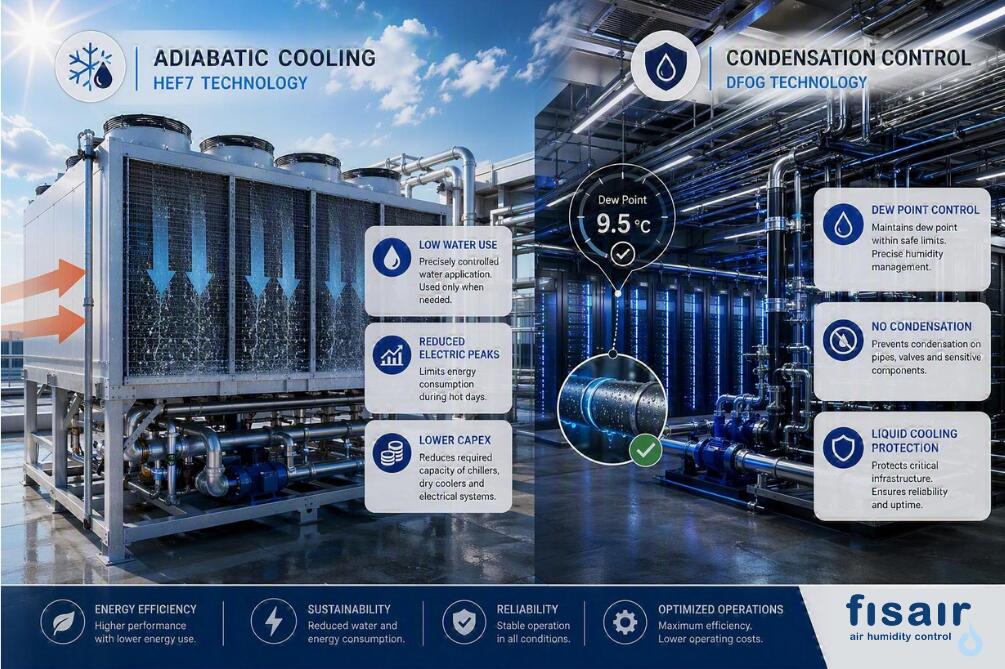
On one hand, adiabatic cooling helps optimize the performance of cooling systems while minimizing the required installed cooling capacity. It is not an alternative to conventional cooling systems, but rather a complementary solution that enhances their efficiency when environmental conditions require it. Thanks to the design of Fisair systems, water consumption remains very low and is limited to periods of peak thermal demand. This avoids electricity consumption spikes during the hottest days of the year, significantly reducing the required cooling capacity and, consequently, the CAPEX associated with chillers, condensers, and other cooling equipment. Through HEF2E solutions, direct evaporation efficiency is improved, while the HEF7 range enhances heat exchange capacity in both dry coolers and chillers. In dry coolers, liquid-to-air heat exchange is made more efficient, while in chillers, the exchange between refrigerant gas and air is optimized, improving the overall system performance.
At the same time, the growth of artificial intelligence applications and high-density computing is accelerating the adoption of liquid cooling systems. These technologies offer high heat removal capacity and enable the management of thermal densities beyond what conventional air cooling can support. However, their implementation introduces a new operational challenge: dew point control and condensation risk.
When liquid cooling circuits operate at temperatures below the air’s dew point, condensation may form on pipes, connections, heat exchangers, valves, and other critical components. Although it may initially go unnoticed, this uncontrolled moisture can lead to corrosion, electrical failures, component degradation, and a significant reduction in infrastructure reliability.
This is precisely where the DFOG range provides a specific solution. Thanks to desiccant dehumidification technology, DFOG allows precise humidity control and maintains the dew point within the limits required for each application. In this way, condensation is prevented even in installations using high-efficiency liquid cooling, enabling operators to leverage all the benefits of these technologies without compromising safety or equipment availability.
The reality is that energy efficiency and condensation control are not opposing goals, but complementary ones. While adiabatic cooling optimizes cold production, reduces peak electricity demand, and lowers investment in mechanical cooling, DFOG solutions ensure the environmental conditions required to operate safely in liquid cooling environments. The combination of both technologies provides an effective response to the main challenges of today’s data centers: higher power density, improved energy efficiency, reduced resource consumption, and maximum operational continuity.
Ultimately, whether by improving the efficiency of air handling units, chillers, and dry coolers through adiabatic cooling or by eliminating condensation risk via advanced dew point control, intelligent air management is becoming a strategic element to ensure the sustainability, reliability, and profitability of future data centers.
Leave a reply