Foundation Felisa x Fisair
On October 29th, 2024, a DANA (Isolated Depression at High Levels) brought intense rainfall and flooding that severely affected numerous areas across Spain, with particular impact in the Valencian Community. The consequences were serious: homes, garages, small businesses, and historical buildings suffered significant damage due to humidity accumulation, water infiltration, and loss of habitability.
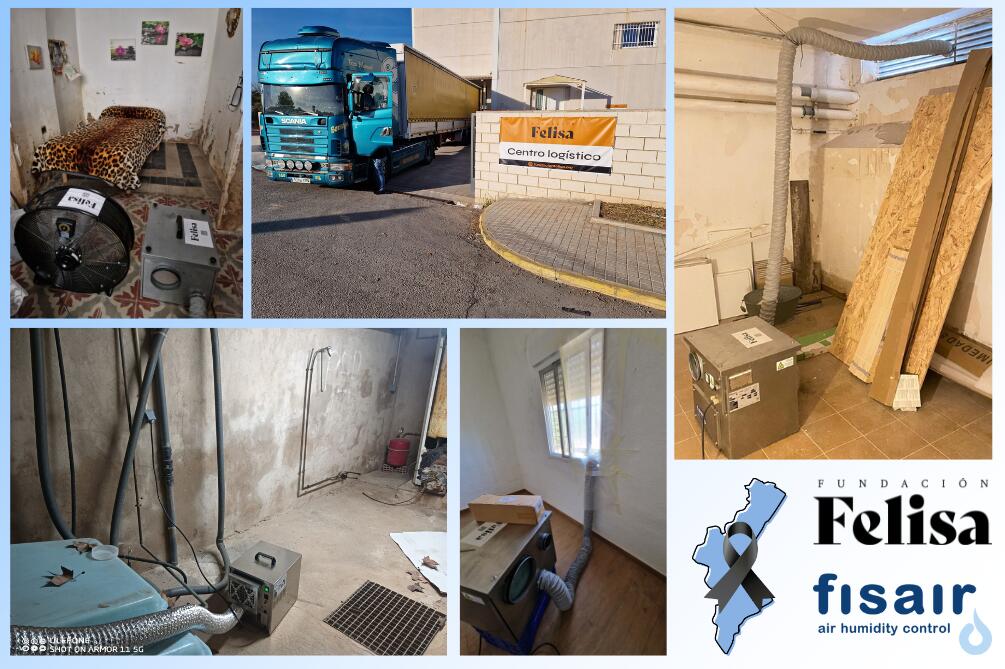
At Fisair, we joined the coordinated response led by the Felisa Foundation, providing technological solutions tailored to the demanding requirements of structural drying. Specifically, our desiccant rotor dehumidifiers from the DFRB series — models DFRB-026 and DFRB-036 — have proven reliable and effective in high-demand technical environments.
Key Interventions in the Valencian Community
Fisair units were deployed in various locations with very different needs and characteristics:
- Alfafarm (Calle Fermín Vilar, 15) – Intervention in a communal garage.
- Guadassuar and Sedaví – Private homes affected by capillary moisture and infiltration.
- Villamarxant – Rural detached house without conditioning.
- Benetússer (Calle Majo, 14) – Communal garage.
- Aldaia (Calle San Francisco, Alquería) – Traditional house with structural moisture damage.
In every case, the DFRB units not only reduced ambient humidity levels but also shortened intervention times and prevented secondary damage such as mold growth, material detachment, or metal corrosion.
DFRB Technology: Desiccant Rotor Dehumidification
The DFRB units are designed for environments requiring precise and continuous humidity control. They feature a silica gel desiccant rotor operating by adsorption: humid air is forced through the rotor, where the gel captures water vapor. A stream of hot air (regeneration phase) then evaporates the trapped moisture, allowing continuous operation.
This technology provides key advantages over condensation dehumidifiers, particularly in:
- Cold environments or those with low relative humidity.
- Spaces with structural moisture accumulated in porous materials.
- Situations requiring fast, stable, and efficient drying.
Technical Highlights
| Model | Process Airflow | Nominal Drying Capacity | Regeneration Heater Power |
| DFRB-026 | 200 m³/h | ~1.2 kg/h | 1.3 kW |
| DFRB-036 | 300 m³/h | ~1.6 kg/h | 1.8 kW |
Both models run on standard single-phase 230 V power, feature quick installation, and can operate indoors or in confined spaces. Their centrifugal fans provide sufficient pressure for short ducting, ensuring efficient distribution of dry air.
Structural Drying Strategies After Flooding
Recovering a building after flooding requires more than ambient dehumidification. Moisture must be removed from:
- Load-bearing walls and enclosures.
- Floor slabs and pavements.
- Buried conduits or crawl spaces.
DFRB units enable a phased structural drying strategy:
- Intensive phase – Elimination of free moisture.
- Stabilization phase – Maintaining a dry environment to prevent reabsorption.
- Protection phase – Ensuring new materials remain unaffected by residual humidity.
Desiccant rotor technology allows operation even at low temperatures, achieving extremely low dew points (down to –20 °C in compact versions, and up to –60 °C in industrial models) — levels unattainable by traditional systems.
Maintenance costs are minimal: only regular filter cleaning, rotor inspection, and regeneration heater checks are required.
Permanent Solutions for Garages and Common Areas
In several affected garages, the Felisa Foundation is currently developing pilot projects for the permanent installation of desiccant systems, financed by homeowners’ associations.
These systems help to:
- Prevent structural damage caused by latent moisture.
- Eliminate odors due to condensation or mold.
- Extend the lifespan of electrical systems, vehicles, and stored materials.
Many communities remain unaware of the benefits of industrial humidity control. The Felisa Foundation is therefore focused on promoting these technical solutions among engineers, builders, and property managers while continuing restoration work.
Conclusion: Technology that Accelerates Recovery and Prevents Damage
The experience following the 2024 DANA demonstrated that desiccant rotor dehumidification technology, such as that of our DFRB units, is a strategic tool for accelerating recovery processes, reducing rehabilitation costs, and increasing the durability of moisture-affected spaces.
At Fisair, we continue to provide reliable, compact, and energy-efficient solutions for engineers, site technicians, property managers, and organizations committed to sustainable rehabilitation.
Would you like to learn more about DFRB units and their applications in restoration, conservation, and industrial drying? Visit our product page or contact our technical team for a tailored proposal.