Marine Corrosion Control in Offshore Environments
The Hidden Cost of Marine Humidity
When discussing corrosion in offshore and marine environments, seawater exposure is often considered the primary threat. However, for many critical assets, direct contact with seawater is only part of the problem.
A much more pervasive mechanism is atmospheric marine corrosion, caused by the interaction between airborne sea salts, moisture, oxygen and metallic surfaces. Studies have shown that chloride deposition from marine aerosols is one of the key environmental variables governing atmospheric corrosion rates in coastal and offshore locations.
Offshore platforms, ships, port facilities, offshore wind farms, coastal power plants and marine storage facilities are continuously exposed to an atmosphere containing microscopic salt particles generated by wave action, wind and sea spray. These aerosols can travel significant distances from the ocean surface and penetrate enclosed technical spaces through ventilation systems, openings and routine operational activities.
The result is an environment where corrosion can develop even in areas that never experience direct seawater contact.
How Sea Salt Accelerates Corrosion
Ocean water contains approximately 35 g/L of dissolved salts, of which about 85% is sodium chloride (NaCl).
As seawater droplets evaporate, they leave behind chloride-rich deposits on exposed surfaces. When relative humidity rises, these deposits absorb moisture from the surrounding air and form a thin electrolyte layer that enables electrochemical corrosion reactions.
In practical terms:
- Higher chloride contamination means faster corrosion initiation.
- Higher relative humidity increases electrolyte formation.
- Condensation greatly accelerates metal degradation.
- Electrical and electronic equipment becomes vulnerable to leakage currents and insulation failures.
Research has consistently demonstrated the combined influence of relative humidity, chloride concentration and temperature on corrosion rates in marine atmospheres.
Why Relative Humidity Matters More Than Many Operators Realize
Corrosion doesnot progress at the same rate under all climatic conditions.
According to atmospheric corrosion studies and the ISO 9223 framework, environmental corrosivity depends heavily on:
- Airborne salinity
- Time of wetness
- Temperature
- Relative humidity
These factors are considered primary drivers of atmospheric metal degradation.
Numerous investigations have shown that chloride-contaminated surfaces experience significantly reduced corrosion activity when humidity is controlled below critical levels. Conversely, corrosion rates rise sharply as humidity increases and moisture remains available on the surface.
This makes humidity control one of the few variables that facility operators can actively manage.
High-Risk Areas in Offshore Facilities
Marine-induced corrosion is particularly problematic in enclosed spaces such as:
- Electrical and switchgear rooms
- Instrumentation cabinets
- Control rooms
- Generator compartments
- Turbine enclosures
- Spare-parts storage areas
- Workshops
- Cargo holds
- Maintenance shelters
- Naval and shipbuilding facilities
Although protected from direct seawater exposure, these spaces frequently contain moisture-laden air carrying chloride contaminants. Over time, corrosion can affect structural components, motors, bearings, electrical connections, sensors and control systems.
The consequences include:
- Premature equipment failure
- Reduced asset availability
- Increased maintenance costs
- Unplanned downtime
- Capital replacement expenditure
Dehumidification as a Corrosion Prevention Strategy
Unlike coatings or corrosion inhibitors, dehumidification addresses one of the root causes of atmospheric corrosion: the presence of moisture.
By maintaining stable, low relative humidity levels:
✅ Condensation is prevented.
✅ Salt deposits remain dry.
✅ Electrochemical corrosion reactions are significantly reduced.
✅ Equipment preservation periods can be extended.
✅ Maintenance requirements decrease.
For this reason, humidity control has become a common preservation strategy for turbines, rotating equipment, electrical infrastructure and long-term stored assets throughout the energy, maritime and offshore sectors.
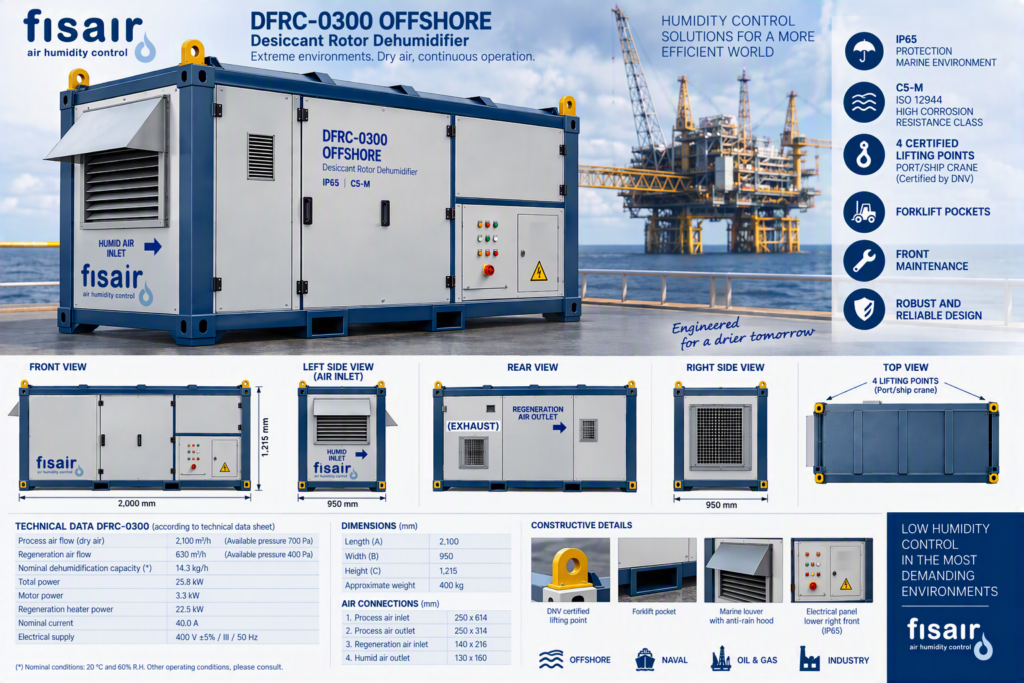
DFRC Dehumidifiers for Aggressive Marine Environments
For demanding offshore and coastal applications, dehumidification equipment must itself be capable of operating in harsh environments.
Fisair’s DFRC series desiccant dehumidifiers have been specifically developed for robust industrial drying applications in aggressive conditions. The units utilize silica gel desiccant rotor technology, enabling reliable moisture removal independently of ambient temperature and allowing operation in situations where conventional refrigeration-based systems may be less effective.
DFRC units feature:
- Robust construction for outdoor and aggressive environments.
- Protective frame and weather-resistant canopy.
- High static pressure capability.
- Drying capacities from 9 to 106 kg/h.
- Airflows ranging from 1,200 to 15,000 m³/h.
- Reliable operation for temporary or permanent installations.
These characteristics make the DFRC range suitable for:
- Offshore platforms
- Shipyards
- Marine vessels
- Port infrastructure
- Coastal power generation facilities
- Turbine preservation projects
- Anti-corrosion coating applications
Protecting Asset Integrity Through Humidity Control
Marine corrosion represents one of the largest lifecycle costs for offshore infrastructure worldwide. While materials selection and protective coatings remain essential, long-term success requires addressing the environmental conditions that enable corrosion to develop.
By reducing humidity, operators can significantly limit the formation of conductive moisture films on chloride-contaminated surfaces and improve the reliability, availability and longevity of critical equipment.